



15 Jan A History of Palafox Street: Pensacola’s Main Street Through Time
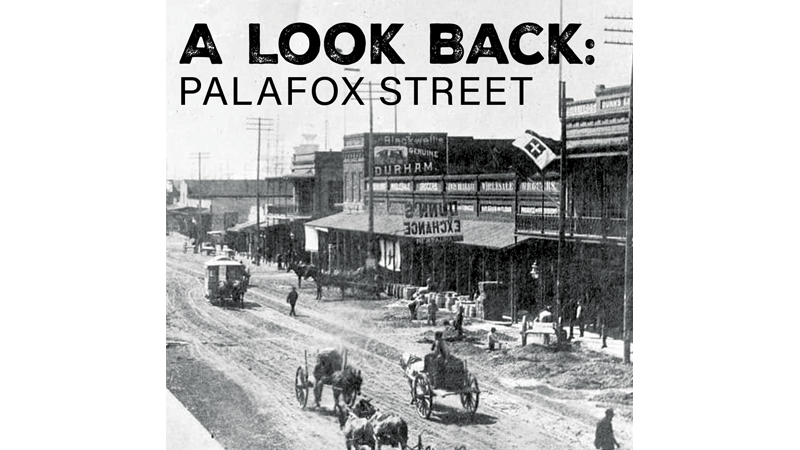
Few streets in Pensacola tell the city’s story quite like Palafox Street.
Running north to south through the heart of downtown, Palafox has long been more than just a roadway—it is the city’s backbone, a commercial lifeline, and a gathering place that has evolved alongside Pensacola itself for more than three centuries. As empires rose and fell, as the nation formed and expanded, and as Pensacola grew from a colonial port into a modern American city, Palafox Street was there to witness it all.
Palafox Street serves as the dividing line for all east–west streets in Pensacola, making it a literal and symbolic center of the city’s layout. Today, it is also the southernmost segment of U.S. Highway 29, terminating at Cervantes Street downtown. The street stretches from Plaza de Luna on Pensacola Bay at its southern end to Michigan Avenue just north of Beverly Parkway and Brent Lane, where it splits into Pensacola Boulevard and Old Palafox Highway.
Named for José de Palafox y Melzi, a Spanish nobleman and military hero, Palafox Street reflects Pensacola’s deep Spanish roots while showcasing layers of British, American, and modern influence – much like the city itself.
Early History: The 1700s
During British control of the colony of West Florida from 1763 to 1783, the street was known as George Street, in honor of King George III. It was laid out after the city was surveyed by British engineer Allies Stanforn, at a time when Pensacola was one of Britain’s most important Gulf Coast strongholds.
As tensions mounted between Britain and its American colonies, George Street existed on the far edge of a continent on the brink of revolution. When the American Revolutionary War concluded and Spain regained Florida in 1783, the street was renamed Calle de Palafox, later Anglicized to Palafox Street. Extending from present-day Garden Street to the waterfront, it quickly became the city’s primary commercial corridor, linking inland settlements to the busy harbor at a time when Pensacola remained under Spanish rule—even as the newly formed United States took shape just beyond its borders.
A Regional Commercial Center: The 1800s
In 1821, Pensacola became the stage for a pivotal moment in American history. Along Palafox Street, in what is now Ferdinand Plaza, General Andrew Jackson—serving as the first American governor of the Florida Territory—formally accepted the transfer of Florida from Spanish to United States control. The ceremony marked the end of more than three centuries of European colonial rule and the beginning of Pensacola’s chapter as an American city. From that moment forward, Palafox Street stood not only as a commercial artery, but as the symbolic gateway through which Florida entered the United States.
As the young nation expanded westward and industrialized, Pensacola’s deepwater harbor positioned the city as a vital port along the Gulf Coast. Palafox Street emerged as the commercial heart of the Florida Panhandle, supporting trade in yellow pine lumber, naval stores, cotton, and seafood, including the region’s well-known red snapper.
During the Civil War, Pensacola occupied a unique and precarious position. While Florida joined the Confederacy, Union forces retained control of nearby Fort Pickens just across Pensacola Bay. By 1862, Pensacola had come under Union occupation for the remainder of the war, and daily life along Palafox Street changed dramatically. Federal blockades strangled Gulf Coast commerce, ships vanished from the harbor, and goods became scarce. Yet Palafox Street endured. Spared the widespread destruction that devastated many Southern cities, the corridor survived the war largely intact—positioned to rebound quickly in the decades that followed and to help fuel Pensacola’s late-19th-century growth and commercial resurgence.
The arrival of rail service further strengthened the street’s importance. Beginning in 1880, the Louisville and Nashville Railroad—and later the Frisco Railroad in 1928—connected Pensacola’s docks at the foot of Palafox Street with destinations across the United States. These connections tied Palafox Street directly into the nation’s expanding industrial economy, accelerating trade, travel, and population growth as America entered the modern age.
The Golden Age: The 1900s
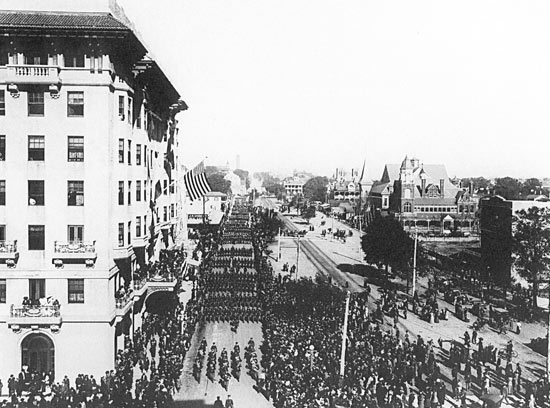

By the early 20th century, Palafox Street had emerged as Pensacola’s primary business and shopping district. Department stores, banks, restaurants, offices, and hotels lined the corridor, illuminated by the city’s first streetlights. Legal, financial, and professional services clustered nearby, supported by the proximity of city, county, state, and federal courthouses.
From the 1920s through the 1960s, Palafox Street served as the center of daily life in Pensacola. National retailers such as Sears, Roebuck, J.C. Penney, Woolworth’s, and Walgreens operated alongside locally owned businesses, while theaters, cafés, churches, and civic institutions made the area a focal point for both commerce and community.
Between Cervantes and Main streets, streetcars once ran along tracks in the median along Palafox Street, carrying residents up and down the city. Though the streetcars are gone, the median remains a defining feature of Palafox today between Wright and Garden streets.
Shifting Tides
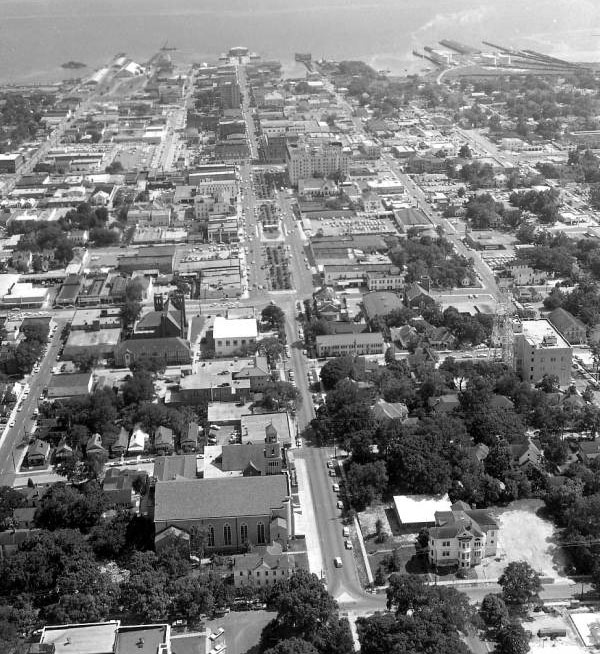
The mid-to-late 20th century brought significant changes to retail patterns nationwide. As automobiles reshaped American life, the construction of Town and Country Plaza in the 1950s and later suburban shopping centers and enclosed malls shifted consumer activity away from downtown.
These decades also coincided with profound social change. As the Civil Rights Movement reshaped communities across the South, Palafox Street remained a public stage – hosting everyday interactions, demonstrations and moments of progress the reflected Pensacola’s evolving civic identity.
Recognizing both its historic importance and its emerging role as a center for arts, culture, and entertainment, the City of Pensacola formally designated the section of South Palafox Street between Garden and Government Streets as Palafox Place in 1979, signaling a renewed commitment to downtown revitalization.
A Living Legacy
Today, Palafox Place is a vibrant downtown destination, home to restaurants, entertainment venues, professional offices, and cultural institutions such as the historic Saenger Theatre. It continues to attract residents and visitors as a walkable district that celebrates Pensacola’s heritage while supporting modern urban life.
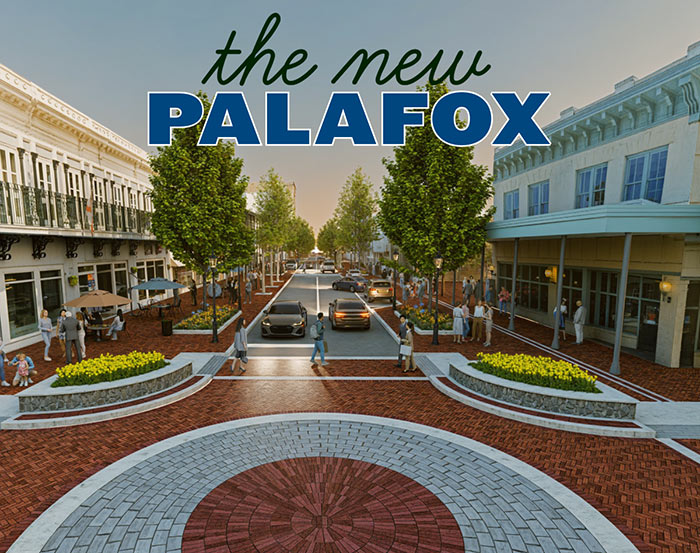
That evolution continues. In 2026, the City of Pensacola initiated Reimagine Palafox, the largest investment ever made in this iconic corridor. This $10.7 million project reflects a long-term commitment to enhancing the safety, accessibility, and character of Palafox Street. Planned improvements include expanded sidewalks, new landscaping and shade trees, brick-paved intersections, enhanced pedestrian safety features, and a modernized stormwater system.
Together, these enhancements are designed to preserve the historic character of Palafox Street while strengthening its role as a welcoming, resilient, and people-centered public space. As it has for generations, Palafox Street will continue to serve as the heart of downtown Pensacola—connecting the city’s past, present, and future.
Proud to Power a City with Deep Roots
For more than a century, Pensacola Energy has grown alongside the city it serves—quietly supporting homes, businesses, and institutions as Pensacola has evolved through moments of progress, challenge, and renewal. Just as Palafox Street has adapted to meet the needs of each new generation, Pensacola Energy remains committed to providing safe, reliable energy while investing in a strong, sustainable future for our community.
As Palafox Street continues its transformation—honoring its past while embracing what comes next—Pensacola Energy is proud to be part of the fabric of this city. Rooted in Pensacola’s history and focused on its future, we remain dedicated to powering the places, people, and possibilities that make Pensacola home.
Sorry, the comment form is closed at this time.