



10 Jan Ask an Expert: Why does natural gas smell like rotten eggs?
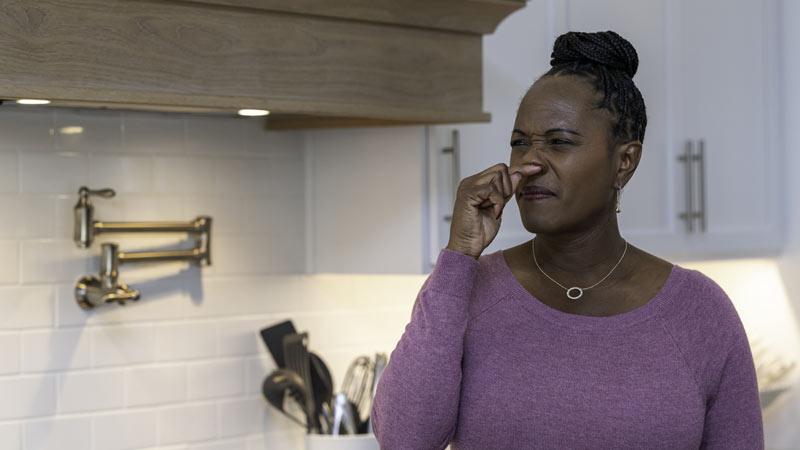
Have you ever caught a whiff of something sulfurous — like rotten eggs — and immediately thought, “Is that a gas leak?”
That reaction is no accident. The nose knows.
In its natural state, natural gas has no smell at all. It’s completely colorless and odorless. Natural gas is not toxic or poisonous. The primary component of natural gas is methane, a simple molecule made of one carbon atom bonded to four hydrogen atoms. Small amounts of other gases — such as ethane, butane, and propane — may also be present, but none of them have an odor you can detect.
So why does natural gas smell so bad? To make leaks easy to detect.
Like many common fuels, natural gas is highly flammable, which is why it is important to be able to detect its presence if it is released unintentionally.
So, natural gas distributors began adding a warning odorant in 1937 called mercaptan — a harmless, non-toxic sulfur-based compound that has a very strong smell, often compared to rotten eggs. Humans can detect it at extremely low levels, making it an effective early warning system.
Because mercaptan blends seamlessly with natural gas, it ensures that even a small leak doesn’t go unnoticed.
That unpleasant “rotten egg” smell may not be appealing — but it’s one of the most important safety features built into your home’s energy system.
If you ever smell natural gas or suspect a leak in your home:
- Leave the premises immediately, taking all occupants and pets.
- Leave doors and windows open, but do not re-enter the building to do so.
- Do not try to find the leak source or turn off valves or appliances.
- Do not operate any electrical, battery or mechanical devices (including phones).
- Call Pensacola Energy Emergency Services at 850-474-5300 from a safe location.
- Do not re-enter the building until it has been made safe.
Pensacola Energy emergency service personnel are on duty 24 hours a day, seven days a week, including holidays.
Sorry, the comment form is closed at this time.